

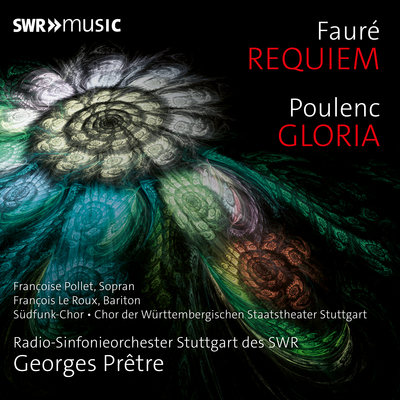
Fauré: REQUIEM & Poulenc: GLORIA
Artikelinfo
1997
2026
Francis Poulenc
Gabriel Fauré
Françoise Pollet
François Le Roux
Südfunk-Chor
Chor der Württembergischen Staatstheater
Radio-Sinfonieorchester Stuttgart des SWR
Georges Prêtre
GABRIEL FAURÉ (1845-1924)
Requiem, op. 48 (Fassung | version: 1900) (39:44)
- I Introït et Kyrie
- II Offertoire
- III Sanctus
- IV Pie Jesu
- V Agnus Dei
- VI Libera me
- VII In paradisum
Françoise Pollet, Sopran
François Le Roux, Bariton
FRANCIS POULENC (1899-1963)
Gloria (1959) (27:40)
- I Gloria 2:46
- II Laudamus te 3:17
- III Domine Deus 5:08
- IV Domine fili unigenite 1:25
- V Domine Deus, Agnus Dei 7:37
- VI Qui sedes ad dexteram Patris 7:27
What distinguishes Fauré’s Requiem from numerous other settings of the requiem text is its rather intimate, restrained, almost chamber-music nature, a ‘lullaby of death’ as it has also been called, an implied criticism of how the work avoids the depiction of the dread of death and the Last Judgement. Fauré's reply was “But this is how I feel about death: as a happy liberation, as a striving for happiness in the hereafter rather than as a painful transition”, which not only perfectly describes essential characteristics of his Requiem, but also reveals it to be a very personal expression of the composer’s own artistic nature.
Two generations later, Francis Poulenc displayed a completely different approach to religion. Like Fauré, Poulenc was from the outhern part of France and had been shaped by his homeland
in the sense of a ‘rural’, intense but joyous Catholicism. He regarded his Gloria as a more exuberant counterpart to some of his other sacred works, and it is in this spirit that the first movement begins in a festive mood with a striking, fanfarelike motif in the full orchestra. If Poulenc cited Gozzoli frescoes with monks sticking out their tongues and Benedictine monks playing football as the source of inspiration for his Gloria, then nowhere is this more immediately exemplified than in the second movement with its rhythmically pointed text of the Laudamus te.
In both the opera house and concert hall, Prêtre’s interpretations were notable for their full-blooded and highly romantic character; in style, they were often different from those of French conductors of the previous generation. He was an effective conductor not only of French repertoire but also of the music of Italy and Germany, a fact reflected by the admiration in which he was held in both countries. A highly experienced and polished recording artist, Prêtre had many years’ experience of working in the studio. His discography is large. Especially important were his recordings of the music of Poulenc.
 Audio sample